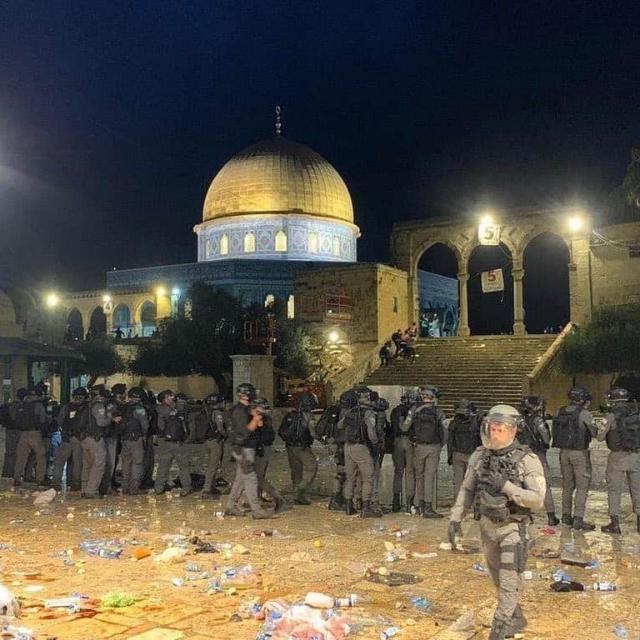
They were worshipping. They were discussing the virtues of faith. They were sitting in the courtyard contemplating the ambiance of a pleasant evening. They were reading the Qur’an. They were gathering in the holiest final ten days of the holiest month of the year, in the holiest mosque in their locality. Then the soldiers came.
On the evening of Twenty Sixth of Ramadan (1442AH) the congregation of worshippers were showered with stun grenades and tear gas by the riot police that had entered the Al Aqsa compound in Jerusalem.
Globally, media channels were showing Palestinians being trapped inside the Mosque and coming under attack. Exits closed by the security forces made escape impossible. TV audiences were watching mobile phone footage from those unable to flee. The cries and screams of women audible amongst explosions from the ordnance being used on them. Even the Medical Centre was not spared from the assault, although this was not shown on mainstream media outlets. Despite that, and other scenes that were not widely shown, what was televised was enough. Enough to generate a global reaction unprecedented in seventy years of news reporting in this region.
From 7th May 2021, a shocked world immediately recognised the inexcusable, and that this time it was the State that was completely culpable. News reporters and interviewers were not willing to defend the actions of the State, rather representatives of the State were cross examined more assertively than we are normally used to. Muslims around the world, have and always will be, furious with the actions of these oppressors, but this time it was a reaction at a heighten level I have never witnessed before. This time there was a heighten level of fury from an increased number of non-Muslims that I have never witnessed before. The reality of life in Palestine was undeniably clear and humanity was near unanimous.
Accountability
The pro-Zionists present numerous arguments and reasonings to justify the righteousness of their cause for the State. For a few weeks from the end of May, time and time again interviewers were being caught out by the myriad of Zionist rationale. The hosts vigour to offer more of a challenge to the Zionist viewpoint was refreshing, however I was generally left frustrated over what was presented. Then on reflection it dawned on me that despite being professionals at cross examination, comprehensively scrutinising the Zionists is not something they have done much of, whereas the Zionists have been refining their rhetoric for seven decades! Preparation for the next inevitable major incident would be sensible. So, here are my thoughts about the typical justifications that the Zionist used in 2021.
Anti-Semitic
The word Israel denotes those people favoured by Almighty God and favoured more than the rest of mankind. The close bond between mortals and The Divine is emphasised by the word and so linguistically to criticise Israel is indeed anti-Semitic. The phrase ‘the Government of Israel’ however is an oxymoron because there is absolutely nothing divine in the policies and actions of the government. Additionally, it is a secular administration and so by their own admission, not the theocracy the name suggests it should be.
As such I refuse to use the word. When you recognise the arrogance that people willing to be so systematically brutal would give themselves such a beautiful name, then you will understand why I am not going to oblige. That is why instead, I have used the phrases ‘the Zionists’ and ‘Zionist State’. Call me anti-Semitic if you wish, but it makes no sense whatsoever for neither labelling the criticism of the State nor linguistically.
The Promised Land
More than three thousand years ago the Jews arrived in Egypt as welcomed migrants. Over time this status was eroded until eventually they became the slaves of the ruling Pharoah. God then commanded Prophet Moses (pbuh) to leave Midian and return to Egypt to liberate the Jews, take them out of Egypt and lead them to the land of Canaan.
Book of Deuteronomy 1:8
Behold, I have set the land before you; go in and take possession of the land which the Lord swore to your fathers, to Abraham, to Isaac and to Jacob, to give to them and to their descendants after them.
Moses, reassured by God, pursued his appointed task with the knowledge he now shared the promise which had been announced to Abraham when he arrived in Canaan with his wife Sarah around a thousand years before Moses.
Book of Genesis 12:7
Then the Lord appeared to Abraham and said, “To your descendants I will give this land.” And there he built an altar to the Lord, who had appeared to him.
So, the Bible is clear that the land of ‘milk and honey’ was promised to Abraham, Isaac, Jacob, and Moses (peace be upon them). The Zionist are more than happy to point out that God promised the Land of Canaan to the Jews, and they were also commanded to drive out the local tribes amongst the Canaanites. However, they very conveniently do not continue to quote the rest of the biblical narrations regarding the Jewish relationship with the Land of Canaan.
Exodus 19:5-6
Now if you obey me fully and keep my covenant, then out of all nations you will be my treasured possession. Although the whole earth is mine, you will be for me a kingdom of priests and a holy nation. These are the words which you shall speak to the children of Israel.
The promise of God was conditional. In return for delivery from slavery, being chosen as the favoured nation, and becoming the inhabitants of Canaan, the believers should obey all of the commandments of God and to be devoted to worshiping Him only. This close relationship between the Creator and the devoted followers would be secured by the declaration from the Jews to a covenant of obedience. Accordingly, Almighty God assured the Jews they would remain His treasured possession.
As instructed, Moses spoke to the Elders, and they agreed to the terms of the covenant. Once the pledge was secured God gave a warning.
Deuteronomy 7: 9-10
Know, therefore, that the Lord your God is God, the faithful God who keeps His gracious covenant and steadfast love with those who love Him and keep His commandments, to a thousand generations. And instantly requites to their face those who hate him, by destroying them; He will not be slack with them who hates God and will requit them instantly.
Should the Jews become disobedient then all of God’s favours would be withdrawn from them. Over time this is precisely what happened.
Jeremiah 52:1-3
Zedeki’ah was twenty-one years old when he became king; and he reigned eleven years in Jerusalem. And he did what was evil in sight of the Lord, according to all that Jehoi’akim had done. Surely because of the anger of the Lord things came to such a pass in Jerusalem and Judah that he cast them out his presence.
Jeremiah 52: 12-13
Nebuzaradan, captain of the guard, a servant of the king of Babylon, [came] unto Jerusalem, and he burnt the house of the Lord, and the king’s house, and all the houses of Jerusalem, and every great man’s house was burnt with fire (Second Book of Kings 25:8-9; Second Book of Chronicles 36:19).
The Babylonians invaded Jerusalem and looted the temple built by Solomon (pbuh). The booty and the Jewish population of Jerusalem and Judah were taken as captives to the City of Babylon. Jews did eventually return to Judah (a more recent name of the kingdom in the south of Canaan) however the Romans arrived thereafter and destroyed the rebuilt temple in Jerusalem. Two thousand years ago Rome did not take kindly to the resistance and rebellion displayed against them and so Jews were exiled yet again. Although a reduced Jewish population remained in Judah, their status of being rulers over their homeland was never reinstated. It was these invasions following God withdrawing His protection that resulted in the Jews settling in an extensive area across three continents. Clearly God giveth the Jews authority over Canaan and God taketh away.1
So, to the Zionists this begs the question, why quote specific sections of the bible and miss out the rest of the relevant passages? God promised to give you a land. God gives you the land. Then for two thousand years you lose that land. How do you explain that?
If the promise of The Almighty was based on the devoted servitude to God, how is it that the present secular government based on mans’ authority (and therefore not on the authority of God) is fulfilling this holy covenant?
Christians believe in Moses. Muslims believe in Moses. Certainly, all three faiths hold Jerusalem in absolute awe. Christians would not be Christians if they were not convinced that they followed the correct interpretation of God’s Word. Likewise, Muslims believe Moses (Musa (AS)) is a true prophet of Islam and believe in the holy scripture sent to him (AS) from Allah (SWT). Therefore, the Zionists cannot claim exclusive right over Palestine based on the Bible. At best, the Jews have a one third stake based on that premise.
The Old Testament in the Bible is made up of two sets of Divine revelation: the Torah and the Psalms (Tawrah and Zubur in Arabic). And so it pains me to point out my next observation – we live in a secular world. If the framework of world affairs is not dictated by any religious text, then why is the fate of the Palestinians upheld by selected Biblical passages?
“There is no justice, no law, and no God in heaven, only a single law which decides and supersedes all – settlement [Zionist settlement of Palestine]”2.
Russian writer Ze’ev Jabotinsky
Historical
For the Zionists, the tie with any historical merit or link with antiquity is a cornerstone of justification for their ongoing actions. Accordingly, in this region, is there a distinction between the events detailed in scripture and what academia calls history? There are undeniable overlaps between the two and as I am clearly happy to accept details from either divine passages or from the textbooks of history, then I have no interest in clarifying any distinction. Setting that aside, I will restrict this section with what is generally accepted as fact.
The Jews, the Christians and the Muslims have all had periods in history when they each exclusively had absolute authority over the lands of Palestine. The Muslims ruled for the longest total number of years, when applying the basis of ruling by holy dogma. Next in length came the various types of Christian leaderships. Jews ruling based on scripture is difficult to pinpoint. Idolatry plagued the ancient Israelites for centuries. Exactly who had authority and on what basis they ruled, is far too complex for the simplistic summary that Jews ruled for 2,000 years. However, the Zionist quest for archaeological evidence is aiming for the period of history that is beyond criticism. That is, the reigns of King David (pbuh) and King Solomon (pbuh); a period of history around 80 years in length. In the unlikely event any archaeological dig does find something of real significance, then all it will do is prove what we already know. That the sincere Kings of the Jews ruled for a short period in history within the monotheist rulers, and even shorter within the whole history of the region.
The Jews know their history and concede the Babylonians removed thousands from Jerusalem and the surrounding areas. The Romans also removed Jews from Judah around two thousand years ago. Exactly how many, how extensive and when exactly did these exiles take place are details that are contested amongst historians. All the same, they do not dispute that the exodus did occur. This eventually led to Jews living for centuries across Europe, Russia, Mesopotamia, and Africa. In fact, the second half of the Zionist slogan acknowledges this point – “a people without a land”
Roman expansion not only moved eastwards, England to the West was also conquered by the Romans 2,000 years ago. The indigenous population of Celts fled to the more remote parts of Scotland, Wales, and South-West England. They also crossed the sea to escape into Northern France. What contempt would the citizens of Brittany receive should they ever declare an ancient right of sovereignty over England? Would anybody anywhere take such a claim seriously?
Throughout the realm and over the centuries, roman citizens converted to Christianity and the religion was officially adopted by the Empire in 325 AD. The Romans surrendered the city of Jerusalem in 637 to the besieging Muslims. The Christians of Jerusalem agreed to the peace terms offered by the Muslims, and each side signed the Treaty of Umar. The conditions included that no churches would be desecrated, and no Christians would be forcibly converted to Islam. In contrast, twenty-three years earlier, a general massacre was ordered when the city was conquered by the Persians.
Four centuries later, the Christians of Europe determined that the occupation by the infidels of the Holy Lands should no longer be tolerated. Pope Urban II called all Christians of Europe to go to war against the Muslims and the age of the Crusades began. Within a few years Jerusalem was captured and so from 1099 AD Christian rule resumed over Palestine. Within a century European Christianity was driven out by the Muslims and Islamic rule as previously outlined resumed. This basically remained the situation until the British Army arrived in 1917.
These two examples outline that the most recent struggle for controlling Palestine was between Muslims and Christians. On a time-line basis Christians have a precedent significantly higher than any Jewish claim for control over Palestine.
History is the study of what takes place and how every incident has a multiple sequence of circumstances that brings it all about. Thus, the details of scrutiny over what happened are what determine if a certain historical injustice required rectifying. What serious objective academic could not conclude that the historical injustice over living in Palestine has consistently been dealt against the Arabs? Only thorough academic study offers acceptability (if at all) about whom has the right of ownership over territory and not any superficial slogans based on a simple appraisal of living somewhere two thousand years ago. Otherwise, rhetoric could legitimise Denmark claiming sovereignty over the Northern half of England! It is a ridiculous proposition and should be treated as such.
“If it is proper to ‘reconstitute’ a Jewish state which has not existed for two thousand years, why not go back another thousand years and reconstitute the Canaanite state? The Canaanites, unlike the Jews, are still there.”3
H.G. Wells
This is War
The Zionists present the case that their righteous cause is prey to the narrow-minded, hostile Arabs. The Zionists are in a fight for survival, and that they are merely reacting in self-defence. At the moment the Zionist State was created, the war of survival began, and this permanent state of emergency has remained to this present day.
This initial war they are describing is when Jordan, Egypt, Lebanon, Syria, and an expeditionary force from Iraq entered Palestine on 15th May 1948.
Following the Ottoman defeat from the First World War, Britain was formally granted a Mandate to take control over Palestine, on 20th April 1920. Both before and during World War I, Britain had informally and formally promised various Arab and Kurdish tribes independence from Ottoman rule. Further embellishments persuaded specific tribes to join the British to fight the Ottomans. These independent kingdoms would of course, be based on certain territorial boundaries. Without the tribes’ knowledge, these ‘promises’ were frequently in contradiction with each other, most notably when the Foreign Secretary, Arthur Balfour, suddenly signed the public statement in 1917 that declared Britain’s aim was to establish “a national home for the Jewish people” in Palestine. Hence, when in control of Palestine, the United Kingdom could not settle the divisions between the Arabs and the Jews. Eventually, in February 1947, Britain transferred the responsibility of deciding how to divide Palestine to the United Nations. By mid-May the United Nations Special Committee on Palestine (UNSCOP) was created, and on 29th November 1947, the United Nations formally approved the Partition Plan for Palestine.
At that time, one third of the population was Jewish and the remaining two thirds were Palestinian. Despite that, the UN plan allotted more land to the Jews, which was roughly double that allocated for the Palestinians.
On 29th April 1948, the British Colonial and Foreign offices issued a public statement announcing the administration of the Mandate for Palestine would terminate at midnight on 14th May 1948. Hence the invasion date chosen by the neighbouring Arab countries was 15th May 1948 (the initial war against the Zionist State).
There are different views when the military attacks began. Some claim it was as early as December 1947, others that they began later in February 1948. Even if we take the latest of these dates, it should be noted that these hostilities began three months before the War commenced. These are some of the details of those assaults:
- Haifa came under mortar attack on 21st April 1948. Haifa had a population of Palestinians numbering 75,000. Within two days those indigenous residents were reduced to a mere 2,000.
- The strike against the city of Acre began on 23rd April 1948. Alongside the use of conventional weapons, illegal biological warfare was also deployed against the inhabitants. Secretly, the water supply was deliberately poisoned with the typhus bacteria. This only gained international attention because British doctors working in the city were among those that inevitably became ill.
- On the 25th April 1948, a continuous mortar bombardment on the town centre of Jaffa was carried out for three consecutive days.
These military operations were part of the overall strategy designated ‘Plan Dalet’. Dalet is the fourth letter of the Hebrew alphabet. This plan was so detailed and well organised that each and every individual military unit of the Haganah had precise and unique aims. Haganah would eventually become the IDF. The targets were all Palestinian towns and villages.
Mounting operations against enemy population centres located inside or near our defensive system in order to prevent them from being used as bases by an active armed force. These operations can be divided into the following categories:
- Destruction of villages (setting fire to, blowing up, and planting mines in the debris), especially those population centres which are difficult to control continuously.
- Mounting search and control operations according to the following guidelines: encirclement of the village and conducting a search inside it. In the event of resistance, the armed force must be destroyed and the population must be expelled outside the borders of the state.
Extract from Plan Dalet March 1948
Other plans and operations were carried out by the Irgun and the Lechi militia groups. The most infamous of these Zionist assaults was that carried out by 120 combatants on Deir Yassin, which was a small village of stone masons located near Jerusalem. On 9th April 1948, as the orders specified, Deir Yassin was surrounded on three sides. It had been anticipated that capturing this location would be a simple formality. It turned out the resistance was fierce, the solid stone houses built by the Palestinians proving to be ideal protection for the defenders. With four members of Irgun killed, dozens wounded and not succeeding in securing the objective, the elite Palmach Unit of the Haganah (17 men) undertook the operation instead. Within an hour they had completely liquidated all the resistance fighters, which my research suggests numbered seven men4. With the village now under control, the Haganah including the elite unit withdrew, leaving the original militia factions behind.
The Irgun and Lechi felt humiliated by how swiftly the Palmach had dealt with the Palestinians. These remaining units then unleashed their frustration and vengeance (revenge for the death of their comrades5) against those villagers left sheltering in their homes. Accounts describe how hand grenades were thrown into houses and Palestinians, including young teenagers, were taken out and shot. All historians now accept that one hundred men, women and children were killed on that day (making 107 in total). All across the Arab world the resulting backlash of those events continue to be remembered by the headlines originally used in 1948 – ‘The Massacre of Deir Yassin’.
As massacres go, one hundred people killed may appear insufficient for it to be described in such genocidal terms. Indeed, many point out that the details were exaggerated and some call it a blood libel (a false accusation) instead. Opinions have also been expressed that as unfortunate as the Palestinian deaths were, they are within the expectant limits of the collateral damage that such incursions create and therefore excusable. However, when you realise that the total population of the village was only 750, then the full scale of what took place should be obvious. What other word should be used to accurately describe the killing of 14% of the population within such a small location?
Pro-Zionists will point out that it was actually the Arabs that began widespread attacks on Jewish settlements shortly after the announcement from the United Nations in November 1947. Perhaps, however once again the narrative of the situation across Palestine is conveniently not fully disclosed. Historians accept that many Palestinian villages initiated non-aggression pacts with their Jewish neighbours. Deir Yassin being amongst those that had just such an agreement. So why then did the Zionists make no distinction between aggressive Arabs and those that were offering peace?
On 3rd February 1948, after Haganah or Irgun units had attacked nearby communities, the 603 residents of Al Haram (16 km north of Jaffa) abandoned their village due to the fear of an imminent raid on them too. The Sidna Ali Mosque and its surrounding cemetery is the only trace left of this former village.
It is clear that a sophisticated Zionist military operation was planned and executed well before the War that began on 15th May 1948. It was this plan of expelling Palestinians from their homes that resulted in huge numbers of refugees arriving in the Muslim countries that bordered Palestine. Only with the arrival of the fleeing Palestinians did the full scale of what was happening become fully understood. The public outrage across these Arab Nations was so immense that the rulers had to act. The only way for these leaders to avoid humiliating themselves in front of the masses was to announce military intervention. The initial reluctance of the Muslims rulers intervening prior to the arrival of refugees, is best illustrated by the Egyptian Government’s decision to go to war. Their decision to involve themselves in the joint Arab offensive was delayed until a full two days before 15th May 1948. The invasions into the Zionist State in mid-May were actually a reaction to the initial military actions on Arab areas within Palestine, which had begun months earlier. In other words, the Zionists started the war, not the Palestinians and not the other Arab States.
By the end of 1948 well over 700,000 Palestinians had become refugees after 530 of their villages were either emptied of their population, partially/fully destroyed or both (de-populated and destroyed). At least 190 of those locations had been laid to waste before 15th May 1948.
The Zionist State has initiated every war it has fought apart from the Yom Kipper War in 1973, which began after a surprise attack by Egypt and Syria. Other than this exception, the Zionist State has always been the aggressor.
“The thesis that the danger of genocide was hanging over us in June 1967 and that Israel was fighting for its physical existence is only bluff, which was born and developed after the war.”6
General Matityahu Peled
“We must expel Arabs and take their places”
David Ben-Gurion 1937
Continues in Part 2
Reference
1 Before the invasion of the Babylonians the Assyrian army captured the Israelite capital at Samaria and carried away the citizens of the northern Kingdom into captivity. This left the southern kingdom of Judah to fend for itself against the warring Near-Eastern kingdoms. These and other details I omitted to simplify the details for those unfamiliar with Biblical narratives. The Seleucid Empire also ruled over Palestine.
2 page 108 Righteous Victims by Benny Morris
3 H. G Well was quoted in Palestine Dilemma: Arab Rights Versus Zionist Aspirations, by Frank C. Sakran, Public Affairs Press, 1948, p. 204.
4 A small group of Palestinian villages (i.e. more than one village) were usually defended by between 30-40 fighters. I read in passing that it was seven armed Palestinians killed in Deir Yassin in April 1948. Based on the average that would defend an area of villages, should seven be under counted, then it would not be much higher for a single village.
5 Five soldiers in total were killed at Deir Yassin.
6 Ha’aretz, 19th March 1972.

 Abdul’s World