What a Difference a Belligerent Makes
A government at war will use every means at their disposal to weaken the enemy. The cancellation of trade agreements, the exploitation of diplomatic relations, also the coordination of blockades and sanctions. Accordingly, the consequences are prone to be grave or cruel, if the appropriate action is not properly identified, especially in urban areas.
The horrendous aftermath of the Battle of Solferino at the end of the Franco-Austrian War was witnessed by the Swiss businessman, Jean-Henri Dunant, in June 1859. In his book A Memory of Solferino he described the appalling suffering and mistreatment of the vast number of casualties. He outlined how the misery had been compounded by the lack of compassion and insufficient medical care. The political campaigning of Dunant brought about the introduction of the First and Second Geneva Conventions, and the establishment of the International Red Cross organisation. Both Geneva Conventions would guarantee the following rights during any war, and were signed by all the European powers:
- the immunity from capture and destruction of all establishments (including medical ships) for the treatment of soldiers and sailors that were either wounded or sick
- the impartial reception and treatment of all wounded combatants
- the protection of civilians providing aid to the wounded
- the recognition of the Red Cross symbol as a means of identifying persons and equipment covered by the agreement.
- the protection of shipwrecked military personnel at sea during war.
In reaction to modern warfare the secular powers accepted the importance of distinguishing between combatants and non-combatants. And throughout the twentieth century the range of defining what were non-hostiles was widened and refined. However, it was these first two Geneva Conventions that acknowledged the premise on how war was conducted. Traditionally, war was declared by sovereign nations against another sovereign nation. Should the aggressor decline to acknowledge that the enemy was a sovereign state, they would elect to declare the enemy as a belligerent instead7.
The Zionist State refuses to recognise the Gaza Strip and the West Bank as sovereign nations8. Thereby, denying the sovereignty that the Palestinians have wanted for the last seventy years. The Zionist also refuse to acknowledge them with the alternative belligerent status too. Therefore, what has happened to the Palestinian people cannot be described as war. Although, after both World Wars the premise of lawful warfare changed (which I will cover later), certain aspects of war still require formal recognition of the enemy as being either a belligerent or a sovereign nation. Otherwise, they are not legitimate actions. Consequently, using the principles laid down by every definition of armed conflict, the Zionist state consistently conducts military acts cruelly, harshly, and illicitly.
“How can we return the occupied territories? There is nobody to return them to”9
Golda Meir 8th March 1969
Minimal Casualties
The Zionists present the case that their righteous cause is prey to either terrorists or narrow-minded Arabs applauding indiscriminate rocket attacks upon residential areas. Despite this, the obligation of compassion is said to be upheld, even towards such untroubled transgressors. Therefore, the Zionists claim to undertake maximum effort to minimise civilian casualties.
Throughout the [Guardian of the Walls] operation, the IDF maintained its core objective: defeat terror, protect [the State], and while doing so, minimizing civilian harm. The IDF dedicated vast resources to mitigate harm to civilians in the Gaza Strip. The IDF took all possible precautions to avoid harming civilians during operational activities. Some of the advance warning methods that the IDF uses include messages to civilians, ‘roof knocking’ and phone calls.
Statement from the IDF website
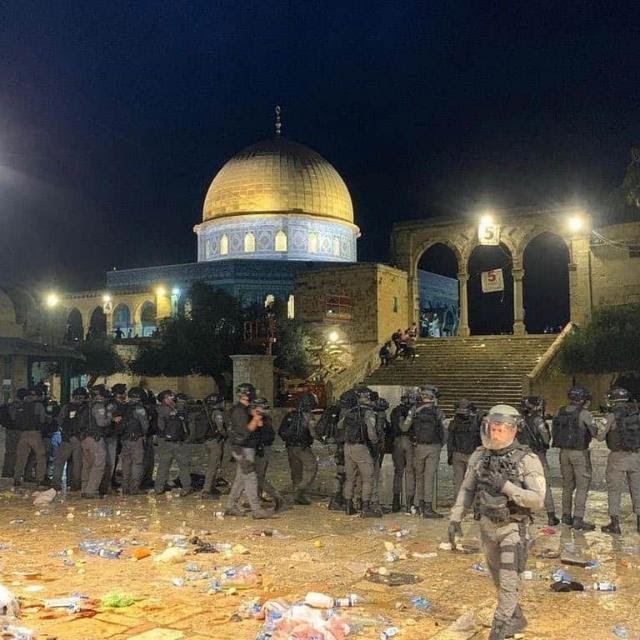
The events of 7th May 2021 need no elaboration, as they clearly illustrate who the actual aggressors were and who was targeted. Although, initial BBC reports said that at least 163 Palestinians were hurt by the actions of the Police, no fatalities have been reported.
The UN announced that the State should call off any evictions10 and employ “maximum restraint in the use of force” against protesters. There is a history of evidence that the Zionists constantly elect not to use minimum force, and as a result, fatalities normally do occur.
Comparatively recently, from 30th March 2018, residents from Gaza organised demonstrations at the border with the Zionist State. These protests were mainly against the State’s economic blockade on Gaza, which had been in force since June 2007. The protests continued every Friday for almost 21 months. This regularity, and the huge turnout at these rallies, rapidly led to them coming to the attention of the international media.
On 15th May 2018, the presenter Jon Snow11 asked Mark Regev, the Ambassador to the UK, about the use of live ammunition by Zionist State soldiers (IDF) on these peaceful protestors. Regev replied, “We use live rounds when it is necessary to protect our people.” Regev went on to explain that the firing methods used were very surgical, “as careful as one can be in a very difficult combat situation”
Regev maintained that the use of live ammunition was required in self-defence. Regev claimed that far from being peaceful, Palestinians charged the fence attempting to enter the Zionist State. Regev said because many of the Palestinians were armed with petrol bombs, they clearly had intentions to attack Jewish settlements that are located near to the border with Gaza. Therefore, it was necessary to use live ammunition to protect citizens of the Zionist State.
What Snow may not have known, at the time of the interview, was the reality at the border with Gaza. To begin with, the fence is electrified. After this fence, there is a buffer zone along the entire length of the border, which is between 350 metres and 1,000 metres wide. This buffer zone is a killing zone, anybody entering this zone can expect to be immediately shot.
Now that I know this, I think it would have been fair to ask,
So you are expecting the viewers to believe that the Palestinians were charging an electric fence, in order to cross 500 metres of a killing zone – then march another 500 metres (at least) to reach a settlement – in order for those that have managed to remain alive, to throw petrol bombs at it – only at that point to realise ‘oh dear, to get back home we have to cross the killing zone again, we didn’t think of that!’ – are you really expecting the British public, at home, to believe all of that?
What Snow did come up with, was an impressive question. Snow pointed out that 1,360 Palestinians had been wounded, “many of them in hospital with appalling injuries”. Snow then asked Regev, “What would an attack [by the IDF] that was not measured, that was not targeted, what would that look like?”
Regev’s answer did not address Snow’s point12.
What a surgical, targeted, measured, response did look like, however, was 223 protesters being killed over those 21 months. Meaning, that there was an average of 2½ fatalities for each day of the demonstrations.
December 2008
The attack on Gaza called Operation Cast Lead, began on 27th December 2008 at precisely 11:25am. That seems an odd time to begin a military assault. It isn’t noon, or at the start of any other hour. Neither was it the time of sunrise or dusk. So why 11:25am?
Palestinians value education enormously and parents devote immense effort and encouragement to see that their children are thoroughly educated. Despite the struggles of day to day living in Gaza, in 2007 the enrolment ratios for higher education were 46.2% for Palestinians, which was amongst the highest in the world.
In Gaza, children will either attend the morning or afternoon school shift. This means, that as the morning session closes, the other children will be making their way to the school to begin their lessons in the second shift.
11.25am is the exact time when the maximum number of children are on the streets of Gaza.
This is not a conflict. This is not war. It is slaughter!
“[houses were destroyed] not in battle, but as punishment…and in order to chase away the inhabitants”13
Moshe Dayan 1967
Hamas Are Terrorist
‘Hamas are terrorists’ is a phrase that is frequently used at the start of answering a question often to deflect attention and thereby avoid answering the question altogether. If that phrase is used for that reason, then dealing with it would allow the questioner to go back to the original point.
If this is a matter of terrorism, then by your own admission this is a matter for a Police investigation and not a matter for the Army.
The American ‘War on Terror’ is not the same thing, as the USA clearly made a distinction between military matters and police matters. The actual wars undertaken by the United States, were the invasions of the sovereign nations of Afghanistan and Iraq. In contrast, the Oklahoma and Boston bombings were both subject to Police investigations. ‘The War on Terror’ is merely a simple slogan, formally useful for that simple minded President. The actions of the USA however clearly demonstrate distinctions were made between dealing with the crimes of terrorism and carrying out military warfare. I am not commenting on the legality over any of these wars, only that Afghanistan and Iraq fit the definition of armed conflicts, and they are clearly separate from police affairs. After all, the United States did not order a full-scale military response against the neighbourhoods where Timothy McVeigh or the Tsarnaev brothers lived.
And do not forget to repeat the original question you asked the Zionist before they tried to distract you with mentioning terrorism.
Actions speak louder than words, which is a case in point too, on the subject of Hamas. I will not excuse nor deny that Hamas is responsible for violent intentions, both in speech and action. However, it is public record that Hamas have always agreed to every demand asked of them by the Zionist State. It is Hamas that have continuously been prepared to negotiate peace without requesting any recompense. For example, in talks, Hamas has never insisted that Jewish settlements are surrendered to the Palestinians. The only consistent item that Hamas refuses to compromise over is the surrender of Jerusalem to the Zionists.
The predicted balloting results of the Palestinians in Gaza is another case in point. Hamas were forecast to lose the elections that were due to take place shortly after Operation Guardian of the Walls was launched. Why would you begin a military assault on 10th May 2021 against a terrorist organisation that is expected to be voted out of office twelve days later, on 22nd May? As Hamas now have an excuse to postpone the elections, surely this recent military attack on Gaza was far more counter-productive than usual.
Collective punishment is unjustifiable across the civilised world. Not only is it inexcusable to punish the masses for the actions of the few amongst them, but it is also counterproductive. Time and time again, throughout history this has been demonstrated. The French and US reprisal during the war against the Viet Cong, and the experience of the British in Northern Ireland, especially after Bloody Sunday in Londonderry (the Bogside Massacre in Derry on 30th January 1972), show that arbitrary actions generate less sympathy and more hatred, within the population that is occupied.
Since 2004, there have been nine military assaults unleased on one of the most densely populated areas in the world:
| Operation Rainbow (Rafah) 17 May-1 June 2004 | ||
| 59 Palestinians killed | 13 Soldiers killed | |
| Operation Days of Penitence (Northern Gaza) 29 Sept-16 Oct 2004 | ||
| 130 Palestinians killed | 1 Citizen killed |
Aug 2005
Prime Minister Ariel Sharon ordered all 21 Jewish settlements in Gaza to be dismantled. It was widely propagated that the former warmonger was now a champion of peace and that the Zionist State was implementing a concession of a negotiated agreement. Noting the eviction of all Jewish settlers in Gaza, some political analysists were predicting that the Zionist State was in fact preparing for future ‘no bars held’ military assaults across the whole of the Gaza strip. The possibility of Jewish residents in Gaza becoming casualties was now completely eliminated.
| Operation Summer Rains June-Nov 2006 | ||
| 402 Palestinians killed (277 Militants) | 11 Citizens killed | |
| Operation Autumn Clouds (Beit Hanoun) 31 Oct-7 Nov 2006 | ||
| 82 Palestinians Killed | 1 Citizen killed | |
| Operation Hot Winter 28 Feb-3 Mar 2008 | ||
| 112 Palestinians Killed | 3 Citizens killed | |
| Operation Cast Lead 27 Dec 2008–18 Jan 2009 | ||
| 1,300 Palestinians Killed 6,300 Homes destroyed | 13 Citizens killed | |
| Operation Pillar of Defence 14 Nov-21 Nov 2012 | ||
| 160 Palestinians killed | 6 Citizens killed | |
| Operation Protective Edge 8 Jul-26 Aug 2014 (following the kidnapping and death of three teenagers) | ||
| Over 2,000 killed 18,000 homes destroyed | 6 Civilians killed | 67 Soldiers killed |
| Operation Guardian of the Walls 10 May-21 May 2021 | ||
| 253 Palestinians killed | 13 Civilians killed | 3 Soldiers killed |
The figures seem to suggest that indiscriminate targeting from the Palestinians was safer than pinpoint accuracy. Statistically who appears to be more humane? Do not these figures contradict everything being claimed by the Zionists, especially the assertion that every precaution is taken? And dare anybody ask; one Zionist life is the equivalent to how many Palestinians lives?
The Zionist insist that it is irrational to suggest that the repercussions of provocation from the Palestinians are labelled collective punishments. The situation on the ground, when understood properly, is that the terrorist deliberately hide themselves within civilian areas. This is how innocent people are caught up whenever the Zionist are going after the terrorists. However, the same situation challenges every other police force in the World. This challenge, to identify the guilty amongst the innocents, belongs to the state, not the neighbours to the point of them becoming cannon fodder. Appropriately, no other government in the world applies arbitrary tactics similar to the Zionists.
The families of those deemed terrorists will find that their homes, where those accused lived, will be completely bulldozed down. One terrorist in a single household will result in the whole family becoming homeless, and no evidence of family involvement is ever required for the order of demolition to be issued. How is that not collective punishment? And these are not isolated injustices undertaken, it is policy and routine.
If the Palestinian majority intended to un-elect the political party that has been labelled a terrorist organisation, then what else does a population have to do to avoid collective punishment?
And the first line of the Hamas constitution is not to destroy the Zionist State. This might seem trivial to point out, however in the interviews following the storming of the Al Aqsa compound, I kept hearing the Zionist repeating that phrase. As it is something that I have never heard before, I decided to check it out for myself.
The introduction of ‘The Covenant of the Islamic Resistance Movement’ contains verses from the Qur’an. The first one used being verses 109-111 from Surah Al-Imran. There should not be any surprises in these verses, which are not too dissimilar from the Bible pointing out how the Jews broke their covenant with God14.
After the introduction, Article One translates as:
“The Islamic Resistance Movement: The Movement’s programme is Islam. From it, it draws its ideas, ways of thinking and understanding of the universe, life, and man. It resorts to it for judgement in all its conduct, and it is inspired by it for guidance of its steps.”
It is not until you reach the fourth paragraph of article seven do you get any sense of what the Zionists were referring to. Somehow, announcing to the world that article seven of the constitution preaches the hatred that they are describing, does not quite have the same ring to it, does it? So why mention it at all?
“The method of collective punishment so far has proved effective.”
Moshe Dayan
“If I were an Arab leader, I would never sign an agreement with Israel. It is normal; we have taken their country. It is true God promised it to us, but how could that interest them? Our God is not theirs. There has been Anti-Semitism, the Nazis, Hitler, Auschwitz, but was that their fault? They see but one thing: we have come, and we have stolen their country. Why would they accept that?”15
Prime Minister David Ben-Gurion
International Law
‘We have a right to defend ourselves’ is universally an acceptable principle. And on the face of it, that is what appears to be happening as a reaction, whenever the terrorists fire their Qassam rockets.
The Kellogg-Briand Pact signed by fifteen Nations on 27th August 1928 and ratified by a total of sixty-two countries, was the first major step to fundamental changes on the subject of International Law concerning warfare. As the Zionist are always insistent that they abide by International Law, and frequently, this is always a sticking point when interviews take place, then some of the extensive details on this subject need to be explained. As already pointed out, the truth appears self-evident, however I ask a quick judgement is reserved prior to coming to terms with some background information.
In 1625, the Dutch theologian, diplomat, and lawyer, Hugo Grotius published his book On the Law of War and Peace. In which, he pointed out that war was how nation states resolved disputes between themselves: “Where judicial settlement ends, war begins.” explained Grotius. Thereby warfare was not seen as an injustice, rather it was a means to establish justice.
As mentioned earlier, the protocol was to declare war against another sovereign state. In the absence of not wanting to see the enemy as a state in their own right, then the declaration of war would name them as a belligerent instead.
Once two states were at war, other countries were legally obliged not to favour one side over another. So, if you traded with one nation at war, then you could not refuse to trade with their opponents. Should a neutral state refuse to trade with one of the nations at war, then it would be seen that it had failed to uphold the duty to remain impartial in the conflict. Hence, the former neutral country could be attacked in retaliation – and that would be perfectly legal. So, for those countries not involved in the war, there was no incentive whatsoever to intervene to bring about an early cessation to hostilities. As a result, for example, the United States continued to trade with both Britain and Germany, whilst these European nations fought each other in the First World War.
It was a corporate lawyer from Chicago that would change the premise set by Grotius. Shocked by the lack of initiative to resolve violence, plus the ease in which war could be declared, and noting the horrors and level of destruction the First World War was responsible for, Salmon Levinson was determined to make war illegal. His efforts and campaigning came to fruition at the signing of the Kellogg-Briand Pact (also known as the Peace Pact). A pact designed to bring an end to war.
To maintain world order, Levinson argued that peace could be enforced by not recognising territorial gains by any aggressor: “If it is unlawful to wage war, conquests by war should furnish no legal title.” So it was, that when Japan invaded China (1931), the international community communicated that the conquered Chinese province of Manchuria would not be recognised as ever belonging to Japan.
Although the initial manifestation of Levinson’s proposals failed to prevent another World War, the political and legal loopholes that had been exploited by Japan, Italy, and Germany16 were to be closed off. The newly established United Nations would reserve the right to use force to enforce the peace. Thus, acts of aggression against another country would be faced with an international military backlash. This sort of UN military intervention would require authorisation by the United Nations Security Council. This in effect, was what Saddam Hussein faced after invading Kuwait, in 1991.
The United Nations would continue to recognise sovereign countries retaining the right to defend themselves from armed attack. For example, as the aggressor, it was illegal for Argentina to invade the Falkland Islands in April 1982. This South American Junta Government claimed to have sovereignty over the Islands on two grounds; it had inherited the Falklands (the Malvinas) from Spain in the 19th Century; and it was the closest nation state to the Islands. In other words, they had an historical claim over the Falklands (sound familiar?). In response, the United Kingdom dispatched a military Task Force to liberate the Islands (travelling a distance of over 8,000 miles). In other words, Britain was exercising their right to protect their sovereign territory from the aggressor. Hence, the military action of the British would be legal, on the grounds of self-defence. Consequently, there is no difficulty with naming the conflict ‘the Falklands War.’
With the nations around the World agreeing that war was now illegal, this inadvertently created a problem for the International Red Cross. The Red Cross had a duty to both monitor and prosecute countries that contradicted the Geneva Convention. However, the provisions covered by the Convention only applied to nations at war, and so it was inevitable that countries would attempt to avoid reprimands by claiming that technically they were not at war. After all, what country would willing incriminate itself by accepting it was conducting an illegal war? So, to avoid getting caught up with endless legal disputes, in 1949, it was agreed that the Geneva Convention would be applied to all ‘armed conflicts.’
This meant that from 1949 although starting a war would be illegal, self-defence and armed conflicts would NOT be illegal.
In general usage, words like ‘war’, ‘conflict’ and ‘self-defence’ are used interchangeably to refer to some sort of fighting. Which is why Zionists will happily use the word ‘war’ when commonly understood in this context. However, the Zionist will ensure that their actions are understood as either an act of self-defence or one half of a two-sided armed conflict. In other words, it is essential that the Zionist State is constantly depicted as the victim within the international legal boundaries. In everyday language they may well be at war, however with any hint of legal scrutiny, the Zionists will ensure that they explain any military response as legal, and never concede it is part of an illegal war.
The UN had a second deterrent to dissuade countries from instigating military offensives. And that was, to prosecute the crime of starting a war. Such matters would be judged by the International Court of Justice. The Nuremberg trials of Nazi Germans, after World War Two, are correctly understood to be about crimes against humanity. However, the mostly unnoticed addition element, extremely important for the new world order, was to demonstrate how those responsible for aggressive warfare would be held accountable. As Germany had launched invasions of neighbouring territories, such as Poland and Denmark, the international community wanted it known by what means Levison’s ideas would be implemented.
In summary, the message from the UN is clear – If you declare war, we will fight you, then after we defeat you, we will put you on trial!
- Aggressive war is illegal. The ongoing fighting with the Palestinians is clearly aggressive, and thereby not legal.
- An aggressor cannot claim to have sovereignty over captured territory. This is why the term ‘Occupied Palestinian Territory’ is used to describe the West Bank and the Gaza Strip17.
- An aggressor is subject to trial by an International Court. And in the case of the Zionist State, will this ever happen? Well, actually, it already has.
International Court of Justice
The International Court of Justice (ICJ) is made up of judges appointed by each of the fifteen Members of the Security Council. In 2004 the United Nations General Assembly commissioned the ICJ to render “an advisory opinion on the wall that the [Zionist Sate] has been building in the West Bank”. Amongst the judges the UK was represented by Rosalyn Higgins, and the USA by Thomas Buergenthal. Both are Jewish, and Buergenthal was a survivor of the Nazi holocaust. On 9 July 2004 the ICJ delivered their verdict:
- The ruling on occupying the territories of West Bank and Gaza: illegal
- The ruling on the building of ALL Jewish settlements in occupied territory: illegal18
- The ruling of the occupation of Jerusalem: illegal19
- Based on the above, the building of the West Bank security wall: illegal
On 20 July 2004, the UN General Assembly voted 150-6 to endorse the ICJ Opinion. The Zionist State chose not to participate in the oral phase of the 2004 proceedings.
The Law and Armed Conflict
The Zionist State defends their actions using a method of picking and choosing anything that fits their agenda and rejecting the details that contradict it. Therefore, scruntinization can expose how unsound their justifications are:
Self Defence – can only be argued if there is a legal basis to begin with: The 2004 ICJ ruling means the basis has never been legal. So, the principle of military self-defence is not self-evident after all.
War – The problem that the Zionist State claims it is constantly facing from the threat of the Palestinians, is not on the scale of war. Also, the status of war cannot exist, as long as the Palestinians are not recognised as a sovereign nation or as a belligerent; the Palestinians are not even in a position to sustain themselves as a nation, due to the small land mass and resources that are now under their control; and even if Palestinian sovereignty was recognised, then any declaration of war would be illegal.
Armed Conflict – arises whenever there is fighting between States or protracted armed violence between government authorities and organized armed groups or just between organized armed groups20. The struggle by the MPLA in Angola or the FRELIMO in Mozambique against the Portuguese Army, clearly falls within this definition. In comparison, the potency of the Palestinians is no way near the ferocity of what took place in the former Portuguese Colonies. Neither are the Palestinians at the level of sophistication, or the effectiveness of the IRA – and even then, the British referred to the situation in Northern Ireland as ‘The Troubles’ rather than as a conflict. I would look stupid to object to the Zionist describing certain events as ‘violence’ or ‘criminality’, however to escalation the actions of a minority of Palestinians to the level of armed conflict is simply disingenuous.
International Law – I would argue that all International Laws have been violated by the Zionist State since 1947. I have no doubt that all sorts of legal interpretations could be used to challenge my understanding. However, since 2004, its clear, that should any legal challenges exist, then for them to have any credibility they would need to be submitted as an appeal to the ICJ. The statement ‘the Zionist State does not follow International Law’ is an undisputable fact, since 200421.
UN Resolution 181, however, remains the only International Law that agrees with the Zionists. This was the UN Partition Plan for Palestine, approved in 1947, that created the Zionist State in the first place. However, as outlined earlier, almost immediately (1947/48) military operations began to seize territory designated by the UN for the Arabs. The only UN resolution that agreed with the Zionist agenda and they haven’t even followed that!
There is nothing that the Zionist are not prepared to distort. As well as rejecting God’s covenant, the Zionist also reject the standards set by modern humanity.
A football player that tackles an opponent and then scores an amazing goal appears to have got themselves in to the perfect goalscoring position. However, if on their way to get themselves into that scoring position they fouled five players along the way, why would the goal legally stand? The illegal goal scorer could shout and scream as much as they want about the legal tackle and the goal that followed, however this snapshot of the event, does not change the facts of how that situation all came about.
Why don’t you be honest?
Will there ever be openness and honesty? Would officials acknowledge the relish citizens have at witnessing the misfortune of Palestinians?
https://www.theguardian.com/world/2014/jul/20/israelis-cheer-gaza-bombing
Is it true that the only good Arab is a dead Arab?
In an article published on 19th November 2003 in Ma’ariv, Shmuel Gordon wrote “The Hebrew Encyclopedia defines anti-Semitism as all ‘manifestations of hatred and racism directed against Semites.’ It follows that anti-Semitism also comprises all manifestations of hatred and racism directed against the Arabs.” He went on to point out that across salons, football stadiums and even in marketplaces, it was commonplace to overhear the remarks “the Arabs are murderers”, “death to the Arabs” and “the only good Arab is a dead Arab”.
In other words, such phrases are not necessarily only used by members of the far-right.
In January 2009, a military incursion into the district of Zeitoun was conducted by the Givati Brigade. This unit of the IDF destroyed the local mosque, 27 homes, and killed 48 residents. Most of the victims were either women, children, or the elderly. During those three weeks of Operation Cast Lead, the New York Times reported that “few neighborhoods suffered more than Zeitoun” 22
Inside the only two houses not completely demolished, slogans were found written in Hebrew and English. Amongst that graffiti was the message “The Only Good Arab is a Dead Arab”.
The Knesset has passed a Law in 2010 that the events of 1948 cannot be described as the Nakba (catastrophe). Therefore, within the Zionist State it is legal to deny the existence of one holocaust, whilst in my country it is illegal to deny the other. For the record I do not deny either genocide, yet ironically by not denying either, I potentially still might be labelled a criminal.
“There are no innocents in Gaza, don’t let any diplomats who want to look good in the world endanger your lives – mow them down!”23
Michael Ben-Ari
It’s called Palestine
In August 1938 the population of Jaffa would be oblivious to any sort of danger, whilst trading and undertaking their daily affairs. Two men, dressed in Arab garb, pulling an orange cart, did not look out of place. The cart set beside the orphanage and soup kitchen, would not warrant a second glance, as it was positioned well inside the designated marketplace area. And so it was, that nobody noticed that the two men calmly walked away.
Two children were among those killed in the explosion. At the time, the New York Times reported that 21 were killed and 37 were wounded. It was the Irgun Group that was the political organisation responsible for this act of terrorism.
It is considered that modern day terrorism began in Palestine. Up to the beginning of the twentieth Century the word ‘terrorism’ was always used to describe the atrocities committed by nation states. The deliberate terrorising of civilians by political activists, rather than by a sovereign state, had not been seen in the world before the 1930’s.
The terrorist actions of the Zionists from 1937 not only targeted Palestinian civilians they also attacked British soldiers. When I was a young man, I had the privilege of being greeted by two retired pensioners with “Aslam Alaikum” as soon as they realised that the Englishmen that stood before them was a Muslim. There were on separate occasions; the first was a coal miner with a northern accent; the other a working-class man from the West Midlands. Alarmingly strange both to my ears and my brain trying to figure out how such old men knew this greeting, which was very rare to hear outside of Muslim circles in the early 1990’s. It turned out that both these men served in the British army in Palestine, and both were willing to share their experiences with me.
There cannot be many of these soldiers left that are alive today. A shame, as interviewing such men would make interesting viewing regarding their experiences with the Zionists, contrasting that with their experience with the Arabs. Impartial testimony, not only about the behaviour of the Zionists, but also their pioneering methods of terrorism. None of the British soldiers that served in Palestine were holocaust deniers, as many had seen for themselves what happened to the Jews in Germany. Interesting how the views that contradict the Zionist’s account of history fade to obscurity, and even die altogether, when the eyewitnesses are buried in their graves.
One afternoon, a Palestinian pulled me to one side and asked if I was willing to be filmed talking about what I knew about Palestine. He was working in England, and pleasantly surprised to find an Englishmen so well informed about the situation in Palestine. He explained the enormous satisfying disbelief his friends back home would feel after watching me speak. I have no idea how many people have watched my efforts, nor how much I may (or may not) have lifted the spirits of any Palestinians living in the West Bank. However, it does illustrate the potential impact that those in the media have, should interviews and reports offer a dissecting approach on the activities undertaken within Palestine.
Palestinians love their homeland and suffer as a consequence. It is natural for a human being to offer compassion to an antagonised people, even if those efforts are on the smallest scale of comfort. Why hesitate?
In 1895, Theodor Herzl, the founder of Zionism, wrote in his diary:
“We must expropriate gently the private property on the state assigned to us. We shall try to spirit the penniless population across the border by procuring employment for it in the transit countries, while denying it employment in our country. The property owners will come over to our side. Both the process of expropriation and the removal of the poor must be carried out discretely and circumspectly. Let the owners of the immoveable property believe that they are cheating us, selling us things for more than they are worth. But we are not going to sell them anything back.”24
The Scales of Justice
The determination that an action is just, is done by measuring it against an agreed standard. For every different faith, there is a different set of values. The action of drinking wine is judged differently by Christianity compared to Islam, for example. Similarly, in temporal affairs comparative contradictions are arrived at from the numerous sets of non-religious values that exist.
Judaism, Christianity, humanism, liberalism, morality, ethics, history, International Law, the Geneva Convention – the Zionist State argues that they act rightly when judged against all these criteria. The reality is that none of them do any such thing! Whichever standard of principle is chosen to scrutinise the actions of the Zionist State, without exception, they all conclude they are wrong. That has to be the most impartial judgment that could exist. The conviction over which set of values is worthy to be used, will differ from person to person. However, what can be comprehended is whether or not a judgment has been correctly concluded by the chosen set of values25.
Technology is clearly illustrating the truth that for years and years was only available in the published works of academics. By simply clicking a button, people at home can see the situation in Palestine for themselves. And the world is watching.
Nullus Mundus Iustita
Prime Minister Yitzhak Shamir once said that “the best strategy for Israel is keeping the status quo”
The status quo is not only all of the above, but also includes that the Zionist State
- Used phosphorus projectiles on the main UN compound in Gaza. The Zionists ignored repeated warnings from UN staff and shelled the facility during Operation Cast Lead on 15th January 2009. The IDF claimed that firing was coming from the roofs of the UN buildings – an outrageous and unbelievable allegation! The use of phosphorus had been extensive across numerous civilian areas within Gaza. Both illegal and cynically not minimalizing casualties.
- In 2021 destroyed the building used by the Associated Press (AP) in Gaza. After receiving a telephone warning to evacuate the building, the AP made numerous phone calls to Zionist Government officials in an effort to prevent the military assault, only to be told nothing could be done to cancel the attack. After one hour of that initial telephone call the attack was launched.
- The killing of journalists and other media staff that have included those of British nationality.
- The killing of peace activists visiting from other countries. Most infamous was US citizen Rachel Corrie.
- Maintaining a situation whereby six million people enjoy privileged lives, off the misery of six million others.
Red Cross staff based in Palestine in 1948, were alarmed at what was happening across the region, especially what took place in the town of Acre. They submitted numerous reports to their Head Quarters in Geneva, even including evidence of the deliberate poisoning of the water supply. However, three years after the holocaust, Geneva did not want to make accusations of genocide against the Jews. In the end, the Red Cross accepted a simple apology from the Zionist State.
The principles of international justice will not work for the Palestinians. The situation has always been stacked against them. It began, when the international community deemed it fair that a disproportionate distribution of land was divided in favour for the smallest portion of the population, in 1947. If from the very start, the international community delivered an injustice, why would this trend differ over future decades?26
“I don’t know something called International Principles. I vow that I’ll burn every Palestinian child (that) will be born in this area. The Palestinian woman and child is more dangerous than the man, because the Palestinian child’s existence infers that generations will go on, but the man causes limited danger. I vow that if I was just an Israeli civilian, and I met a Palestinian I would burn him and I would make him suffer before killing him. With one hit I’ve killed 750 Palestinians [Rafah 1956]. I wanted to encourage my soldiers by raping Arabic girls as the Palestinian women is a slave for Jews, and we do whatever we want to her, and nobody tells us what we shall do, but we tell others what they shall do.”27
Ariel Sharon 1956
Peace
The only time peace and equality has existed in this land, and they are a few people left alive that experienced its remnants (that is how recent it was lost!), was the millennium that Islam ruled over the territory.
The peace pacts made by Palestinians in 1947 with neighbouring Jewish settlements are consistent with the legacy of the customs from centuries of Islamic rule. Many Muslims in 1947 were happy to continue to live side-by-side with Jews, as they always had done. This is because Islam teaches that non-Muslims are entitled to fair treatment, especially for Jews and Christians. Under the status of dhimmi Allah (SWT) enshrined the rights for non-Muslim citizens. And because of what has been guaranteed by Allah (SWT), then despite the hardships and injustice that the Palestinians have endured, we are duty bound to restore the multi-faith society that once existed. The legacy of the eleventh century Christian Crusaders did not result in Muslims meeting out injustice to the Christians that continued to inhabit Palestine. The legacy of the Zionists has no bearing on the justice Jews can expect in the future to receive from Muslims.
I can see myself being accused of supporting a violent cause. Despite it being clear, when it comes to restoring political harmony in Palestine, such tactics over the last seventy years have failed and have always been counterproductive. The Zionist, on the other hand not only advocate violence, but they also implement it too. They are literally getting away with murder.
Abdul Aziz Ramadan 1443AH
“For many three hundred years of unbelievable agony in body and spirit creates an indelible scar on the soul. At is worse, murder, brutality, anguish, utter despair. At the least a casual unconcerned prejudice. Is this the sum of substance of black history in America? For many it is. But some say, there must be more than just this!”
References
1 Before the invasion of the Babylonians the Assyrian army captured the Israelite capital at Samaria and carried away the citizens of the northern Kingdom into captivity. This left the southern kingdom of Judah to fend for itself against the warring Near-Eastern kingdoms. These and other details I omitted to simplify the details for those unfamiliar with Biblical narratives. The Seleucid Empire also ruled over Palestine.
2 page 108 Righteous Victims by Benny Morris
3 H. G Well was quoted in Palestine Dilemma: Arab Rights Versus Zionist Aspirations, by Frank C. Sakran, Public Affairs Press, 1948, p. 204.
4 A small group of Palestinian villages (i.e. more than one village) were usually defended by between 30-40 fighters. I read in passing that it was seven armed Palestinians killed in Deir Yassin in April 1948. Based on the average that would defend an area of villages, should seven be under counted, then it would not be much higher for a single village.
5 Five soldiers in total were killed at Deir Yassin.
6 Ha’aretz, 19 March 1972.
7 Using the term belligerent identifies the hostile that war has been formally declared against – who is at war with whom. During the American War of Independence in 1775, Britain was not prepared to recognise than the North American colonies had separate national status. After all the, the King and the British Government saw the colonies as a mere extension of the United Kingdom. Therefore, it recognised the rebellious United Colonies as a belligerent instead.
8 Written in the plural, however the Zionist State also does not recognise the three occupied territories of Jerusalem, West Bank, and the Gaza Strip as a unified sovereign state either.
9 The New York Times reported, in 1948, that the depopulation of Jaffa took only ten hours to be completed. The 45,000 Palestinian residents were reduced to a mere 3,000. Between 1948 and 1967 the Zionist State depopulated a further 36 Palestinian villages. At least 300,000 Palestinians were evicted immediately after the 1967 conquests of the West Bank and Gaza.
10 In 1948 the Transjordan Government purchased a piece of land within the Muslim quarter of Jerusalem to build houses to accommodate a handful of Palestinian families that were amongst the hundreds of thousands of refugees. This area is known as Sheikh Jarrah. Extensive protests have been ongoing for many months because the judiciary of the Zionist State ruled that these homes were illegal. Accordingly, eviction orders were issued to remove the descendants of the originally housed refugees. It is widely accepted that the riot Police stormed the Al Aqsa Mosque because of the protests against the evictions.
11 This interview was broadcast on Channel 4 News.
12 https://www.bbc.co.uk/news/world-middle-east-12156239
13 page 328 Righteous Victims by Benny Morris
14 The subject I covered under the heading The Promised Land in Part 1 of this article. The Book of Deuteronomy from the Bible, Chapter 7, verses 9-10, is what bears the resemblance to the verses of Qur’an, that I am referring to.
15 page 121 Le Paraddoxe Juif (The Jewish Paradox) by Nahum Goldmann
16 It is worth noting that Soviet Russia had also invaded Finland and Poland prior to 1941.
17 Article 2 of the United Nations Charter makes it clear that it is inadmissible for countries to acquire territory by means of war.
18 The ICJ judgement was unanimous i.e. all fifteen judges agreed that all Jewish settlements in the Palestinian Occupied Territories are illegal.
19 This is the basis why President Trump’s administration recognising Jerusalem as the capital city of the Zionist State was challenged as illegal.
20 This definition I took from a training presentation from the Red Cross. An extensive extract from that presentation is given below, under the heading The Law of Armed Conflict.
21 The implication for the Yom Kipper War is that the Zionist State has no recourse to any of the legal principles based on International Law, as troops were illegally in Sinai.
22 Newsweek reported that the survivors of Zeitoun all insisted that they were simple farmers and that the area had never been used to fire rockets.
23 Michael Ben-Ari is an Israeli politician, and former member of the Knesset. During the 18th Knesset, Ben Ari was a member of the National Union Party.
24 page 49 America and The Founding of Israel, by John W. Mulhall
25 It is only a matter of time before the majority of the population is Muslim, so democracy will never be fairly implemented.
26 The International Criminal Court (ICC) based in The Hague, is currently investigating possible war crimes against Palestinians (and vice versa), including IDF actions undertaken on demonstrators at the border with Gaza in 2018. Prime Minister Benjamin Netanyahu lambasted the decision to open the probe as the “essence of anti-Semitism” and declared that the State was “under attack” [from the Hague]. The Prime Minister’s office in April 2021 confirmed it would not cooperate with the inquiry, but it will send a response to the ICC. The United States also criticised the ICC investigation and voiced support for its ally. The ICC was established in 2002 to investigate and prosecute those responsible for grave offenses such as genocide and war crimes. Neither the USA nor the Zionist State are members of the ICC, therefore the ICC has no jurisdiction on either country.
27 Ariel Sharon in an interview with General Ouze Merham, 1956
The Law of Armed Conflict
Before defining these terms, it is worth mentioning why we now refer to conflict and not war. The answer is straightforward. Under the 1945 United Nations Charter, adopted just after the horrors of World War II, the use of force by one State against another is prohibited (Article 2). States may resort to force in the exercise of their inherent right of individual or collective self-defence (Article 51) or as part of military sanctions authorized by the Security Council (Articles 43-48). Since then, therefore, States have avoided declaring war. The 1949 Geneva Conventions adopted the more general term “armed conflict” deliberately to cover the complete range of situations and to avoid legal arguments over the exact definition of war. States today are less inclined to speak of war or admit that a state of war exists, but as we all know armed conflicts certainly do.
An armed conflict arises whenever there is fighting between States or protracted armed violence between government authorities and organized armed groups or just between organized armed groups.
An international armed conflict arises when one State uses armed force against another State or States. The term also applies to all cases of total or partial military occupation, even if the occupation meets with no armed resistance. It is now irrelevant whether the States concerned consider themselves to be at war with each other or how they describe the conflict. An international armed conflict is considered to be over once active hostilities or territorial occupation have ceased. POWs still held by the parties nevertheless remain under the protection of the law until their ultimate release.
Non-international armed conflicts, also known as internal armed conflicts, take place within the territory of a State and do not involve the armed forces of any other State. One example is the use of the State’s armed forces against dissident, rebel, or insurgent groups. Another is two or more armed groups fighting within a State, but not necessarily with the involvement of government troops.
Just as military operations have principles of attack, defence, withdrawal, etc., so does the law of armed conflict – containing a set of clearly defined principles. These principles are practical, reflect the realities of conflict and, most important of all, do not include anything that a professional soldier could not apply in battle. They strike a balance between humanity and military necessity, and are valid at all times, in all places and under all circumstances. You are not free to do what you want. As commanders or staff officers, it is of the utmost importance that you know and understand these principles. They must be taken into account as a matter of routine in any military appreciation, planning and indeed training that you undertake. Soldiers under your command must also understand them. You will find the following principles throughout the law of armed conflict.
You must always clearly distinguish between combatants and civilians or the civilian population as such. Combatants may of course be attacked unless they are out of action, i.e. they are hors de combat. Civilians are protected from attack but lose that protection whenever they take a direct part in hostilities for the time of their participation. Similarly, you must always distinguish between military objectives which can be attacked and civilian objects which must be respected. The word “object” covers all kinds of objects, whether public or private, fixed, or portable.

 Abdul’s World